How to Talk to a Girl at the Dog Park
Let the dogs open the door — then walk through it yourself. Walk over, say something light about how the two dogs are getting along, and give her an easy choice: "I'll sit down if they sort themselves out — otherwise I'll stay back." Never joke at her dog's expense; to her, it's a joke about her. And don't stay silent. At the dog park, silence is the most expensive option.
The situation
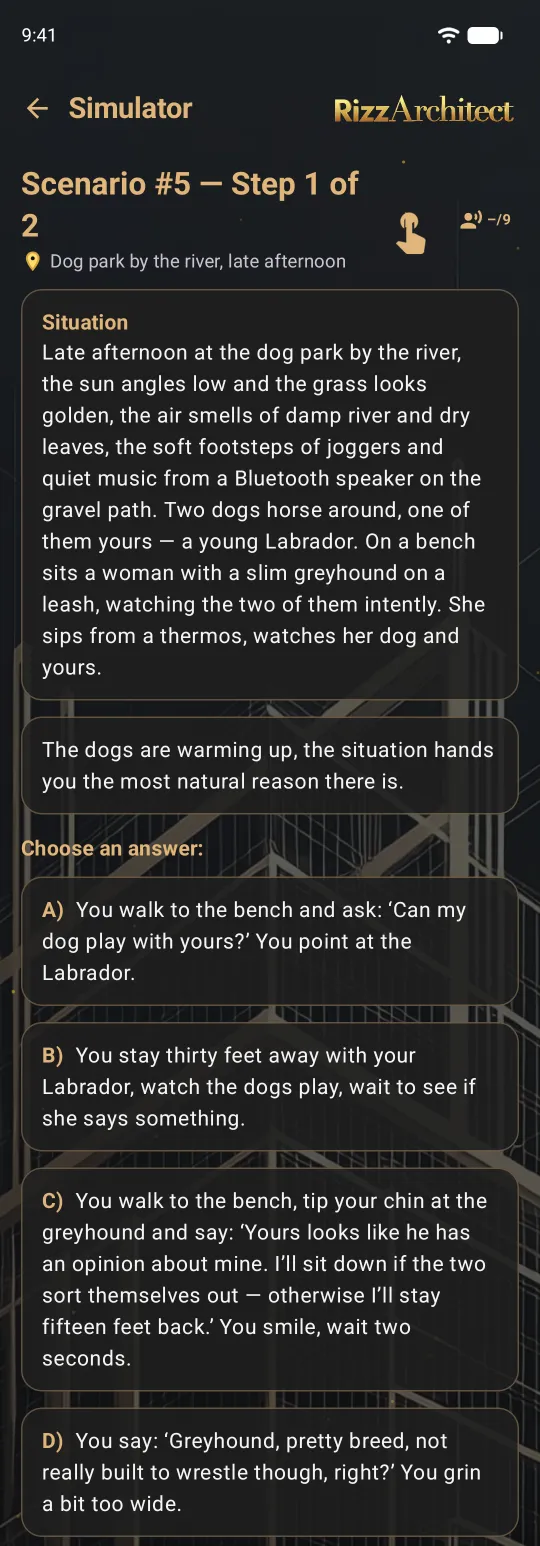
Late afternoon at the dog park by the river. The sun is low, the grass looks golden, the air smells of damp river and dry leaves. Joggers pass on the gravel path; someone's Bluetooth speaker plays quietly.
Two dogs are horsing around — one of them yours, a young Labrador. On a bench sits a woman with a slim greyhound on a leash, watching the two of them closely. She sips from a thermos and watches her dog and yours.
The dogs are warming up. The situation hands you the most natural reason there is.
What do you do?
Four ways to play it — and what happens
Pick one before you read on.
AYou walk to the bench and ask: "Can my dog play with yours?" You point at your Labrador.
Score 77 — Ask a practical question
What happens: She nods: "Sure, if Buddy agrees." She unclips him.
Why it falls short: A practical entry, but only a dog question — you didn't open anything of your own. It works as a start, but it needs your own sentence after it. The dogs alone don't carry a conversation; they just open the window.
BYou stay thirty feet away with your Labrador, watch the dogs play, and wait to see if she says something.
Score 31 — Watch from a distance
What happens: The dogs play for ten minutes. She watches, you watch, nobody talks. In the end she gets up and leaves with her greyhound.
Why it fails: At the dog park, staying silent while the dogs play is the most expensive silence there is. An opening you don't use — dog, book, question — vanishes with the moment, and it doesn't come back the same day.
CYou walk to the bench, tip your chin at the greyhound and say: "Yours looks like he has an opinion about mine. I'll sit down if the two sort themselves out — otherwise I'll stay fifteen feet back." You smile and wait two seconds.
Score 100 — Use the dogs, then give her the choice
What happens: She laughs and pats the bench next to her: "Sit down. Buddy finds your Lab amusing. You'll know if it turns." She slides over.
Why it works: You used the dogs as a bridge and set a small, playful stake that leaves the decision to her. The dogs provide the reason; you provide the line.
DYou say: "Greyhound — pretty breed, not really built to wrestle though, right?" Your grin is a little too wide.
Score 45 — Joke about her dog
What happens: She says briefly: "Buddy runs more than yours, trust me." She pets him and turns slightly away.
Why it fails: The joke was aimed at the dog, but she hears it as an opinion about her choice. Her dog is part of her — a joke at his expense always hits her, too.
In the app, every answer is scored from 100 to 31. 100 opens the conversation, 77 is correct but flat, 45 costs you the moment, 31 ends it.
Why the easiest setting still gets missed
The dogs open a window. They don't carry the conversation.
The dog park gives you an opener for free: your dogs are already interacting. That's exactly the trap. Because the reason is so obvious, it feels like you can wait for it to do the work.
It won't.
What actually makes the difference
- Use the reason that's already there.When the reason exists, the opener doesn't have to be invented — just used.
- Give her the choice.A small stake ("otherwise I'll stay back") makes saying yes easy — and saying no painless.
- Her dog is part of her.Curiosity and warmth about her dog, never mockery.
- Think one step ahead.A Saturday at the dog park is the most natural second meeting you can suggest.
One honest note: this scenario assumes you have a dog. If you don't, don't borrow one as a prop. The approach works because the reason is real.
Don't memorize the line
Rehearsed lines are obvious, and they never survive the second question.
"Yours looks like he has an opinion about mine" only works when her dog actually looks like that.
What carries over: watch what the dogs are really doing, say what you see with a light touch, and leave her an easy choice.
FAQ
How do I start a conversation at the dog park?
Comment on what the dogs are doing together, add a light sentence of your own, and ask before you sit down. Asking her dog's name is a natural next step.
What should I not say to a dog owner?
Anything critical about her dog — the breed, the behavior, the training. It lands as criticism of her, however playful you meant it.
How do I ask her out from the dog park?
Suggest the most natural next step: a walk with both dogs, on a day you name.
Is it okay to sit next to someone on a bench?
Ask first and give her an easy way to say no. "I'll sit if that's okay — otherwise I'll stay back" respects her space and keeps it light.