What to Talk About on a First Date — When It Suddenly Gets Real
Good first-date conversation isn't about having topics ready — it's about how you respond when she opens up. If she shares something heavy, stay still for a moment, keep facing her, then answer with one short sentence that shows you're there. Don't rush to a compliment, don't dig for details, and don't trade it for a story of your own.
The situation
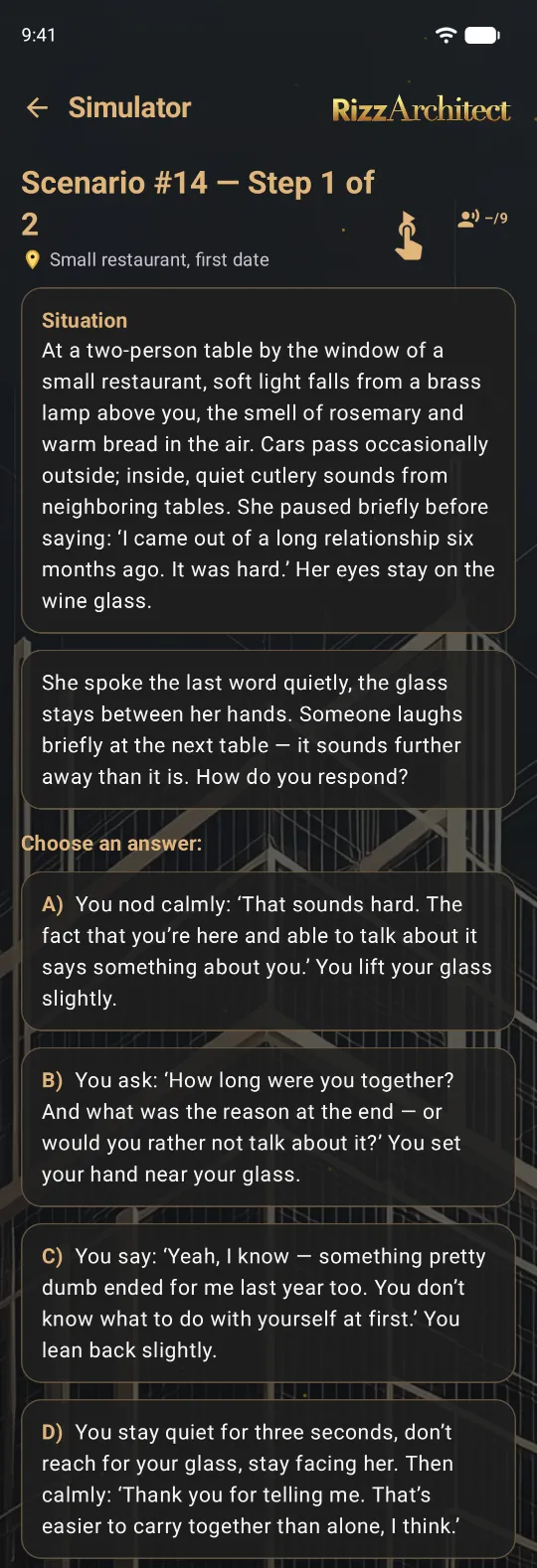
A two-person table by the window of a small restaurant. Soft light from a brass lamp, the smell of rosemary and warm bread, quiet cutlery sounds from the other tables.
She pauses briefly before saying: "I came out of a long relationship six months ago. It was hard." Her eyes stay on her wine glass.
She said the last word quietly. Someone at the next table laughs — it sounds further away than it is. How do you respond?
Four ways to play it — and what happens
Pick one before you read on.
AYou nod calmly: "That sounds hard. The fact that you're here and able to talk about it says something about you." You lift your glass slightly.
Score 77 — Too quickly positive
What happens: She smiles thinly: "Thanks, that's kind to say." She sips her wine, and the conversation drifts back to the surface.
Why it falls short: Respectful — but you moved to the positive too fast. That's a compliment where she needed you to listen. A "but you're so strong" delivered too early feels warm to the person saying it, and like a softly closed door to the person hearing it. Let the heavy thing stand before you frame it.
BYou ask: "How long were you together? And what was the reason in the end — or would you rather not talk about it?"
Score 45 — Ask for the details
What happens: She answers briefly: "Eight years. And — complicated." She shrugs and takes a sip.
Why it fails: Instead of listening first, you asked two factual questions — the second with an out, but it still moves toward an interrogation. Digging into a wound she has just opened says: my curiosity is stronger than your pace. Questions come only after you've acknowledged the moment — and never two in a row.
CYou say: "Yeah, I know — something pretty dumb ended for me last year too. You don't know what to do with yourself at first." You lean back slightly.
Score 31 — Make it about you
What happens: She nods politely, smiles briefly, and her eyes go back to the glass.
Why it fails: You turned her moment into your story. She hoped you'd simply be there; she got a swap of hard-luck stories. "Mine was like that too" feels like empathy, but it pulls the spotlight onto you.
DYou stay quiet for three seconds, don't reach for your glass, and keep facing her. Then, calmly: "Thank you for telling me. That's easier to carry together than alone, I think."
Score 100 — Silence first, then one sentence
What happens: "Thanks. That actually… helped. Most people don't know what to say to that." She reaches for her glass, more relaxed than before.
Why it works: You answered vulnerability with presence — silence first, then a short sentence. That's all the moment needed. The sentence shows her you feel for her and quietly offers closeness, without tipping into sappy.
In the app, every answer is scored from 100 to 31. 100 opens the conversation, 77 is correct but flat, 45 costs you the moment, 31 ends it.
Why this moment decides the date
Fill the silence, fix the feeling, or relate — all three take the moment away from her.
Most first-date advice is a list of questions. Lists help for the first ten minutes. What decides the evening are moments like this one — when she takes a small risk and watches what you do with it.
What actually makes the difference
- Order matters.A short pause first, then one sentence that shows you're there.
- Let the heavy thing stand before you frame it.Give her story room before you attach meaning to it.
- One question at a time — and only after you've acknowledged her.
- Look forward, not back.After she's shared something heavy, the strongest message isn't "it gets better." It's "I'm curious what's next for you."
And the topics?
Early on, keep them light and specific: the place you're in, what she's been into lately, plans she's excited about, a small story from your week. They're the warm-up. The real connection happens in the moments when the topic stops mattering — and you're the one who stays calm.
Don't memorize the line
Rehearsed lines are obvious, and they never survive the second question.
"Easier to carry together than alone" works at this table, after this sentence, with this pause before it. Said on cue, without the pause, it sounds like something you read online.
What carries over isn't the sentence. It's the order: stillness, presence, then a few honest words.
FAQ
What should you talk about on a first date?
Light, specific things early on: what she's into lately, plans she's looking forward to, the place you're in, a story from your week. Then follow whatever she brings up — listening matters more than your topic list.
What do you say when your date talks about her ex?
Acknowledge it briefly and calmly. Don't dig for details, don't compare it with your own past, and don't rush to cheer her up. One short sentence that shows you're listening is enough.
Is it okay to talk about past relationships on a first date?
If she brings it up, yes — at her pace. You don't need to steer there yourself.
How do I deal with silences on a first date?
Short silences aren't the enemy. In a moment like this, a three-second pause is exactly what makes your answer land.