How to Start a Conversation in a Bookstore — When Your Pulse Is Already Up
Notice the nerves, breathe out once, and move before your head recalculates everything. Then ask one light, specific question about what she's reading — "Architecture: hobby or profession?" In a bookstore, the problem is almost never what to say. It's whether you stop hesitating. Waiting for a "better moment" is the most reliable way to lose the one you have.
The situation
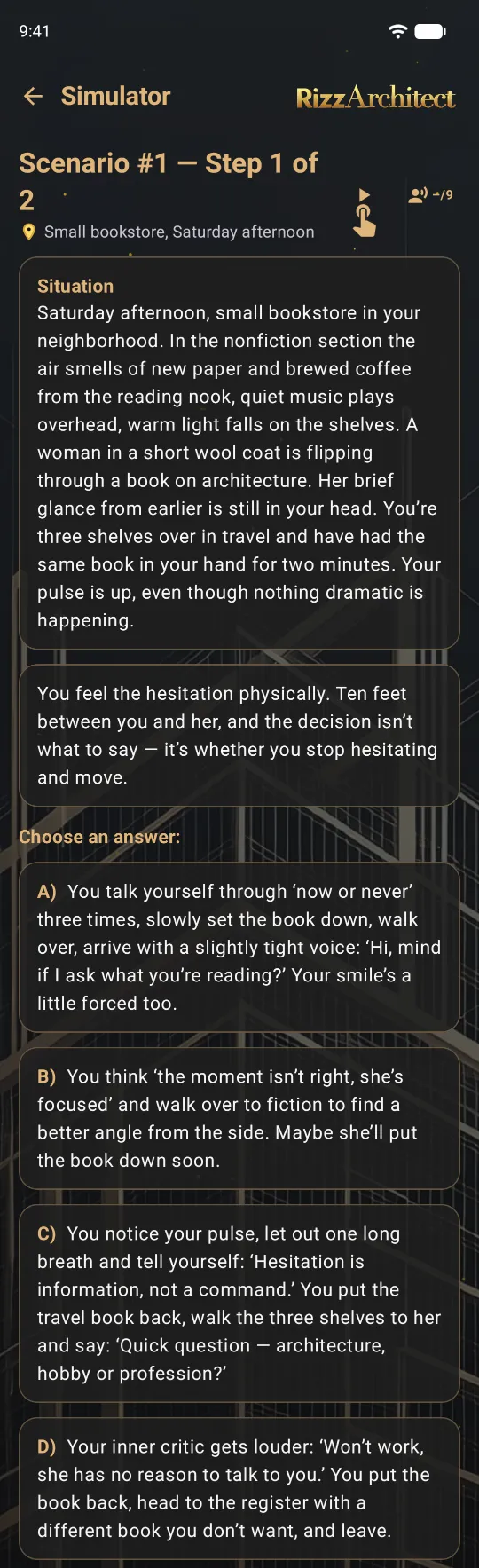
Saturday afternoon, a small bookstore in your neighborhood. In the nonfiction section the air smells of new paper and coffee from the reading nook. Quiet music, warm light on the shelves.
A woman in a short wool coat is flipping through a book on architecture. Her brief glance from earlier is still in your head. You're three shelves over in travel, and you've had the same book in your hand for two minutes. Your pulse is up, even though nothing dramatic is happening.
Ten feet between you. And the decision isn't what to say — it's whether you stop hesitating and move.
What do you do?
Four ways to play it — and what happens
Pick one before you read on.
AYou tell yourself "now or never" three times, slowly set the book down, walk over and arrive with a slightly tight voice: "Hi, mind if I ask what you're reading?" Your smile is a little forced.
Score 77 — Talk yourself into it
What happens: She answers politely, but your tense tone has made her cautious. She nods more than she talks.
Why it falls short: You made the move — but the buildup in your head leaked into your voice, and she felt it. One "now or never" is enough. Saying it three times builds the very tension you were trying to get rid of.
BYou think, "The moment isn't right, she's focused," and walk over to fiction to find a better angle. Maybe she'll put the book down soon.
Score 45 — Wait for the better moment
What happens: You watch for three minutes. She puts the book back and walks over to the travel section — exactly where you were standing a minute ago.
Why it fails: Now you're twenty feet away. Searching for the better moment is the most reliable way to lose the one you have. There's no better moment than this one.
CYou notice your pulse, let out one long breath and tell yourself: "Hesitation is information, not a command." You put the travel book back, walk the three shelves to her and say: "Quick question — architecture, hobby or profession?"
Score 100 — Breathe out once and go
What happens: She gives a short laugh and shows you the cover: "Hobby with ambition." She turns to you.
Why it works: You got your body moving before your head could recalculate everything. And the question is light, specific and easy to answer — with room for her to play. Breathe out once and go. Your body leads; your head catches up.
DYour inner critic gets louder: "Won't work. She has no reason to talk to you." You put the book back, head to the register with a different book you don't want, and leave.
Score 31 — Let the inner critic win
What happens: Outside, you realize you bought a book you don't want just to convince yourself you had a reason to be there.
Why it fails: Your inner critic lies about the cost of approaching. A real "no" is cheaper than an imagined one — and the approach you didn't make hurts longer than any rejection.
In the app, every answer is scored from 100 to 31. 100 opens the conversation, 77 is correct but flat, 45 costs you the moment, 31 ends it.
Why your body says "don't"
Hesitation is information, not a command.
That physical hesitation — tight chest, faster pulse, the book you're not really reading — feels like a warning. It isn't. It's your body reacting to uncertainty, and it will show up every time something matters to you.
You don't have to make it go away before you act. You just have to stop obeying it.
What actually makes the difference
- One breath, then go.Act with the nerves, not after them.
- Shorten the runway.The longer the inner pep talk, the tighter your voice when you arrive.
- Ask about the book, not about her.Light, specific, answerable in a few words.
- Honesty is a valid opener."I didn't want to regret not saying hi" is the most human opener there is — because everyone understands it.
Don't memorize the line
Rehearsed lines are obvious, and they never survive the second question.
"Hobby or profession?" works because she's holding a book on architecture. Hold the line up against a cookbook and it's nothing.
What this scenario really trains isn't a question. It's the three seconds before it — noticing the hesitation, naming it, and moving anyway.
FAQ
How do I stop being nervous before approaching a girl?
You don't have to stop. Nerves are normal when something matters. The skill is acting with them: one long exhale, then move within a few seconds. Waiting until you feel ready usually means waiting until she's gone.
What do you say to a girl in a bookstore?
Something about the book in her hands or the section you're both in — a light, specific question she can answer in a few words, with a little room to play.
Is it rude to interrupt someone browsing books?
No. Browsing isn't deep reading, and a short, friendly question is fine. A brief first answer isn't a no either. Only a clear no is — she turns away from you or says it — and that you respect.
What if I already missed the moment?
It happens to everyone. The moments come back more often than you think — but only if you start acting on them. Every one you take makes the next one easier.