How to Talk to a Girl on the Subway — Seven Minutes Is a Conversation
Use the wait as your reason. Step closer, talk to her directly, and turn something visible — the book she's holding, the countdown on the display — into a light, personal comment. "What is it?" is the polite default and gets a polite answer. A sentence with some of your own color gets a laugh. Seven minutes is a full conversation if you bring the first sentence.
The situation
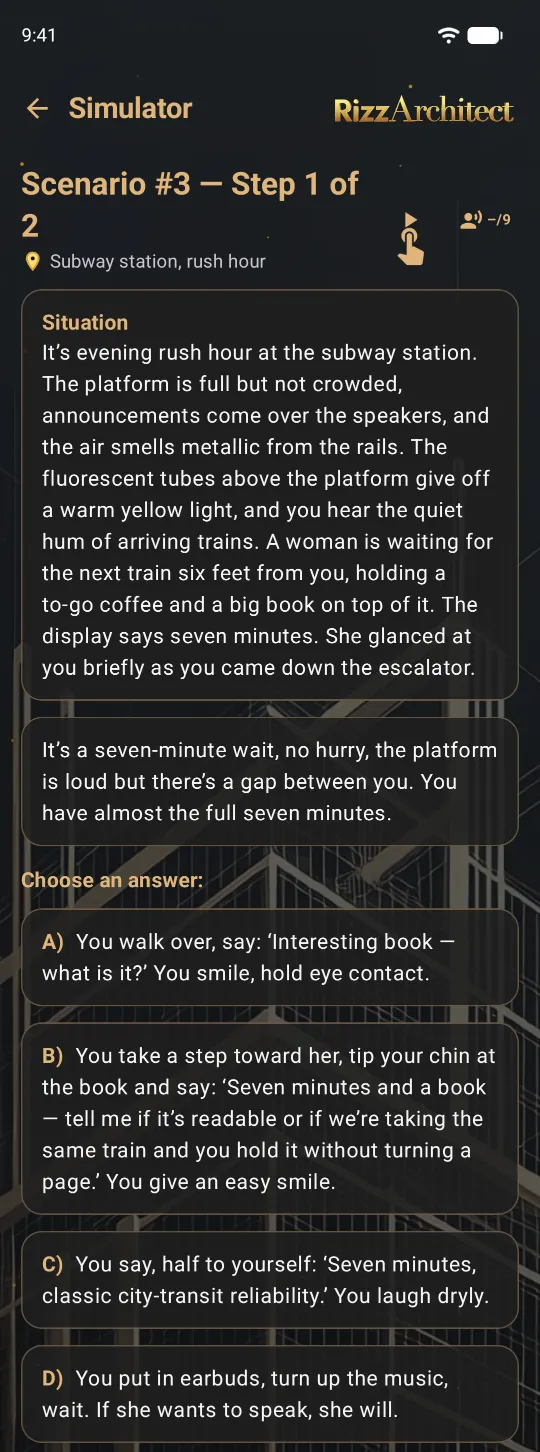
Evening rush hour at the subway station. The platform is full but not crowded. Announcements come over the speakers, the air smells metallic from the rails, the fluorescent tubes give off a warm yellow light.
A woman is waiting for the next train six feet from you, holding a to-go coffee with a big book on top of it. The display says seven minutes. She glanced at you briefly as you came down the escalator.
No hurry. The platform is loud, but there's a gap between you. You have almost the full seven minutes.
What do you do?
Four ways to play it — and what happens
Pick one before you read on.
AYou walk over and say: "Interesting book — what is it?" You smile and hold eye contact.
Score 77 — Ask the default question
What happens: She answers: "A nonfiction book about space travel." She holds up the title briefly, smiles politely and goes back to reading.
Why it falls short: Friendly, direct — but no angle of your own. "What is it?" is the polite default that gets nobody out of small-talk mode. Direct is good, as long as the sentence carries a bit of your own color.
BYou take a step toward her, tip your chin at the book and say: "Seven minutes and a book — tell me if it's readable or if we're taking the same train and you hold it without turning a page." You give an easy smile.
Score 100 — Turn the wait into a game
What happens: She laughs, surprised: "Three chapters in, readable enough." She turns the book so you can see the title.
Why it works: You framed the wait as a small game and skipped the detour through "mind if I ask." The book was the reason; your own angle on it made it a conversation.
CYou say, half to yourself: "Seven minutes. Classic city-transit reliability." You laugh dryly.
Score 45 — Comment to the room
What happens: She smiles briefly, nods once and returns to her book.
Why it fails: You cast the comment into the room, not to her, and it disappeared into the noise of the platform. And a line about the transit system is small talk she hears twenty times a week.
DYou put in your earbuds, turn up the music and wait. If she wants to talk, she will.
Score 31 — Put your earbuds in
What happens: Seven minutes later she steps into the car. You follow, sit two rows over, and you never look at each other again.
Why it fails: Earbuds on a platform are a visible do-not-disturb sign — to everyone around you, and to yourself. The next encounter is over before it starts.
In the app, every answer is scored from 100 to 31. 100 opens the conversation, 77 is correct but flat, 45 costs you the moment, 31 ends it.
Why the subway is underrated
The subway gives you exactly the time you use.
The subway feels like the worst place to talk to someone: noisy, anonymous, everyone in their own bubble.
But it's also the most honest setting there is. There's a natural end point — the train — so nobody feels trapped. And there's a shared situation you can both comment on: the wait.
What actually makes the difference
- Talk to her, not to the room.Step in, face her, and speak loud enough to beat the platform noise.
- Use what's visible.The book, the coffee, the display. The reason is already there.
- Add your own color.Polite questions get polite answers. A playful angle gets a reaction.
- Plan for the split.When the train splits you up, the plan needs a day pinned to it, not a hope. "Maybe see you around" is a hope. "Coffee on Thursday?" is a plan.
Don't memorize the line
Rehearsed lines are obvious, and they never survive the second question.
The book sentence works because she's holding a book and the display says seven minutes.
What carries over: look at what's actually there, give it a small twist of your own, and say it to her — not to the platform.
FAQ
Is it okay to talk to women on public transport?
Yes. Earbuds or a phone aren't a wall. You read the signals after you've said something, not before. A clear no looks different: she rolls her eyes and looks away, turns away from you, or says it. That you respect.
What's a good way to start a conversation on the subway?
Comment on something visible and shared — the wait, what she's reading, the display — and add a light, personal angle. Then talk to her directly, not to the air.
How do I get her number before the train comes?
If it's going well, say so plainly before the doors open and suggest a concrete day. A day you name is a plan; "let's stay in touch" is a hope.
What if she's reading?
A book isn't a wall. On a platform with a seven-minute wait, it's often your best opening. A short answer isn't a no; if she turns away or says no, let her read.